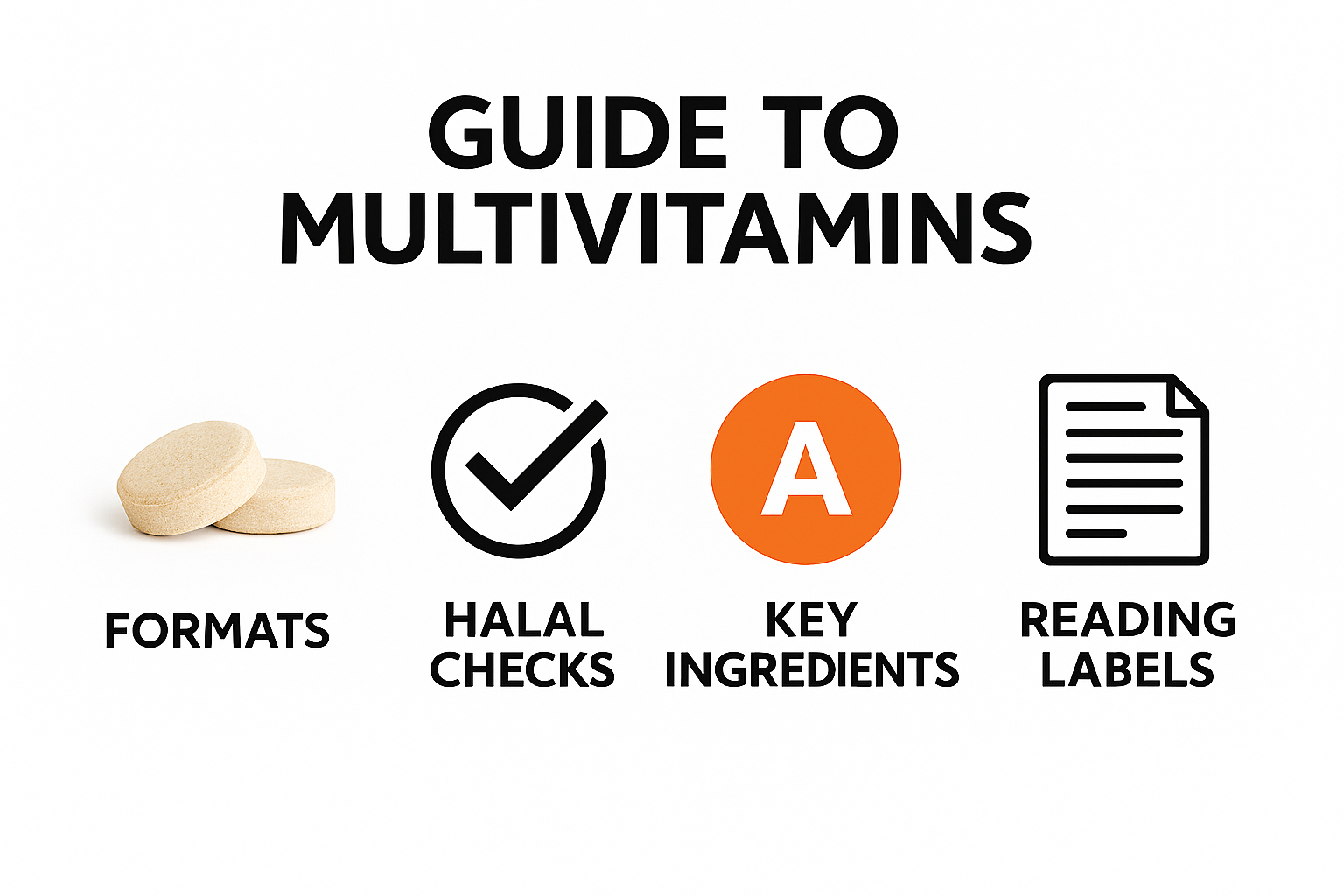
A Complete Guide to Multivitamins: Formats, Halal Considerations, and How to Read Labels Confidently
Multivitamins are among the most commonly used supplements, designed to support overall health by filling nutritional gaps in the diet. With many different formats and formulas, choosing the right multivitamin can be confusing, especially for Muslim consumers who must also consider halal compliance.
What are multivitamins?
Multivitamins combine multiple vitamins and minerals into a single product. They are typically formulated to support:
- Energy production and metabolism
- Immune system function
- Bone and muscle health
- Skin, hair, and nail health
- Overall daily wellness
There are specific multivitamin formulas for men, women, children, seniors, and pregnant or breastfeeding women, as well as blends for energy, immunity, or beauty support.
Multivitamin formats
Multivitamins come in several formats. Each format has its own pros, cons, and halal considerations.
1. Tablets
Tablets are solid, compressed forms of multivitamins and are one of the most common and affordable formats.
- Pros: High nutrient density, long shelf life, cost-effective.
- Cons: Can be difficult to swallow, may contain coatings and binders.
- Halal notes: Check for shellac, stearates, and glazing agents in the “other ingredients” section. Look for halal certification when possible.
- Common users: Adults, seniors, and prenatal multivitamin users.
2. Gummies
Gummy multivitamins are chewable and flavored, making them popular with children and adults who dislike swallowing pills.
- Pros: Easy and pleasant to take, especially for kids and pill-averse adults.
- Cons: Lower nutrient content per piece, added sugars or sweeteners, more sensitive to heat.
- Halal notes: Gelatin is a key concern. Avoid pork and non-halal bovine gelatin; choose gummies made with fish gelatin, halal-certified bovine gelatin, or pectin. Check vitamin D3 and flavoring sources for halal compliance.
- Common users: Children, teens, and adults who prefer chewables.
3. Capsules
Capsules contain powdered ingredients inside a shell made from gelatin or plant-based materials.
- Pros: Easy to swallow, minimal taste, often fewer additives than tablets.
- Cons: Less space for very high doses, may require multiple capsules per serving.
- Halal notes: Standard capsules often use gelatin that may not be halal. Look for “vegetarian capsule,” “cellulose,” or halal-certified gelatin on the label.
- Common users: Adults and those seeking cleaner ingredient profiles or herbal multivitamin blends.
4. Softgels
Softgels are smooth, one-piece capsules usually filled with oils or fat-soluble nutrients such as vitamins A, D, E, and K.
- Pros: Easy to swallow, ideal for oil-based and fat-soluble vitamins, good protection from light and oxygen.
- Cons: Typically made with gelatin, not suitable for vegans and some halal consumers unless certified.
- Halal notes: Look for softgels made with halal-certified bovine or fish gelatin, and preferably halal-certified manufacturing.
- Common users: Adults taking multivitamins enhanced with omega-3, vitamin D, or other oils.
5. Powders
Powdered multivitamins are mixed into water, juice, or smoothies and can be useful when larger servings or flexible dosing are needed.
- Pros: Flexible dosing, good for larger serving sizes, often faster absorption, helpful for people with difficulty swallowing pills.
- Cons: Require preparation and mixing, taste and texture may not appeal to everyone.
- Halal notes: Often closer to halal-friendly, especially plant-based powders. Still check flavorings, emulsifiers, and sweeteners, and choose halal-certified products where possible.
- Common users: Children, seniors, athletes, and those who prefer drinks over pills.
6. Liquids
Liquid multivitamins are taken by spoon or measuring cup and are popular for children, older adults, and those with digestive or swallowing difficulties.
- Pros: Fast absorption, easy to swallow, flexible dosing, useful for people who cannot take pills.
- Cons: Shorter shelf life, may require refrigeration, often contain preservatives or flavoring agents.
- Halal notes: Check that flavor extracts are alcohol-free and verify the source of vitamin D3 and other ingredients. Halal-certified liquid products are preferred.
- Common users: Children, elderly adults, and people with special health needs.
Popular types of multivitamins
Multivitamins are often tailored to specific life stages or health needs.
- Adult multivitamins: General wellness, energy, immune support.
- Women’s multivitamins: May include more iron, folate, and nutrients for hair, skin, and nails.
- Men’s multivitamins: Often focus on energy, metabolism, and sometimes prostate support.
- Children’s multivitamins: Usually gummies, liquids, or chewables with age-appropriate doses.
- Senior multivitamins: Can emphasize bone, heart, and eye health, with nutrients like vitamin D, calcium, B12, lutein, and zeaxanthin.
- Prenatal and postnatal multivitamins: Formulated with folate, iron, iodine, and other nutrients needed for pregnancy and breastfeeding.
Halal considerations in multivitamins
Halal compliance for multivitamins depends on both the ingredients and the manufacturing process. Muslim consumers should pay attention to more than just the main vitamins and minerals.
- Gelatin: Common in capsules, gummies, and softgels. It must be from halal-certified bovine or fish sources.
- Vitamin D3 source: Often derived from lanolin; halal certification helps confirm its acceptability.
- Flavoring and extracts: Some may be alcohol-based, especially in gummies and liquids.
- Coatings and binders: Ingredients such as shellac and certain stearates may be animal-derived or unclear in origin.
- Cross-contamination: Manufacturing facilities may handle non-halal products; halal-certified plants provide more assurance.
Halal-friendly options include pectin-based gummies, vegetarian capsules, fish gelatin, and plant-based vitamin D3 (for example, from lichen). Whenever possible, choosing multivitamins with recognized halal certification gives added confidence.
How to check multivitamin labels
Reading the label carefully helps you evaluate both the quality and halal status of a multivitamin.
1. Serving size
The serving size tells you how much you need to take to get the listed amounts of each nutrient. It may be:
- 1 tablet or capsule per day
- 2 or more gummies per day
- A specific number of milliliters for liquids
Serving size affects how long the bottle lasts, your daily cost, and how convenient the product is for you.
2. Quantity and supply length
The total number of tablets, capsules, gummies, or milliliters tells you how many days the bottle will last at the suggested serving size.
- 60 gummies with a serving size of 2 per day = 30-day supply.
- 90 tablets with a serving size of 1 per day = 90-day supply.
3. Key vitamins and minerals
The main panel lists the vitamins and minerals and their amounts per serving. Common nutrients in multivitamins include:
- Vitamin A
- B-complex vitamins (B1, B2, B3, B6, B12, folate)
- Vitamin C
- Vitamin D3
- Vitamin E
- Vitamin K
- Iron (especially for women and prenatal users)
- Zinc and magnesium
The percentages of daily value help you see whether the product offers meaningful amounts without going too far beyond typical daily needs.
4. “Other ingredients” section
This section lists non-active ingredients that can affect halal status and product quality.
- Gelatin in capsules, gummies, and softgels
- Shellac, glazing agents, and stearates in tablets
- Artificial colors, sweeteners, and flavorings
- Preservatives and stabilizers, especially in liquids and gummies
If an ingredient’s source is not clear, consumers may wish to contact the manufacturer or choose a product that provides clearer information.
5. Certifications
Certifications provide additional assurance about product quality and compliance.
- Halal certification: Indicates that ingredients and processing meet halal standards.
- Vegan or vegetarian: Suggests the absence of animal-derived gelatin.
- Non-GMO and gluten-free: Relevant for broader dietary preferences.
- Third-party tested: Can indicate independent quality and purity testing.
How Compare-Halal.com helps you choose multivitamins
Compare-Halal.com is designed to make finding halal-friendly multivitamins easier and more transparent.
- Format-based filters: Search specifically for gummies, tablets, capsules, softgels, powders, or liquids.
- Halal transparency: See details on gelatin source, vitamin D3 origin, and alcohol-free flavoring.
- Ingredient clarity: Key “other ingredients” such as coatings, binders, and emulsifiers are highlighted.
- AI-supported recommendations: Get suggestions that consider your format preferences and halal priorities.
- Trusted retailer links: Access reputable stores to purchase the products you choose.
Final thoughts
Multivitamins can support overall health, but choosing the right one means looking beyond the front label. Format, ingredients, serving size, quantity, and halal status all matter. By understanding how multivitamins are made and how to read labels carefully, and by using tools like Compare-Halal.com, you can select products that support both your health needs and your values.